
A teething timeline for the first two years

A teething timeline for the first two years
Teething runs on a rough schedule that almost no individual child follows exactly. The order is fairly consistent; the timing varies by months in either direction, and a baby who is early or late is simply early or late. Knowing the sequence is still useful, because different stages call for different shapes.
What follows is the ordinary pattern, and what tends to be helpful at each point. It is a shopping guide, not medical guidance — anything that worries you belongs with a paediatrician, not a general store.
Before anything appears
Plenty of babies chew, drool and gnaw for weeks before a tooth is visible. At this stage the useful items are the simplest: a soft one-piece silicone teether light enough to hold, or a fabric item with a textured edge.
Nothing needs to be firm yet. The point is something safe to mouth that can be washed easily and often.
Around six months: the lower front teeth
The two lower central incisors usually arrive first. They are small and sharp, and the chewing that comes with them tends to be focused on the front of the mouth.
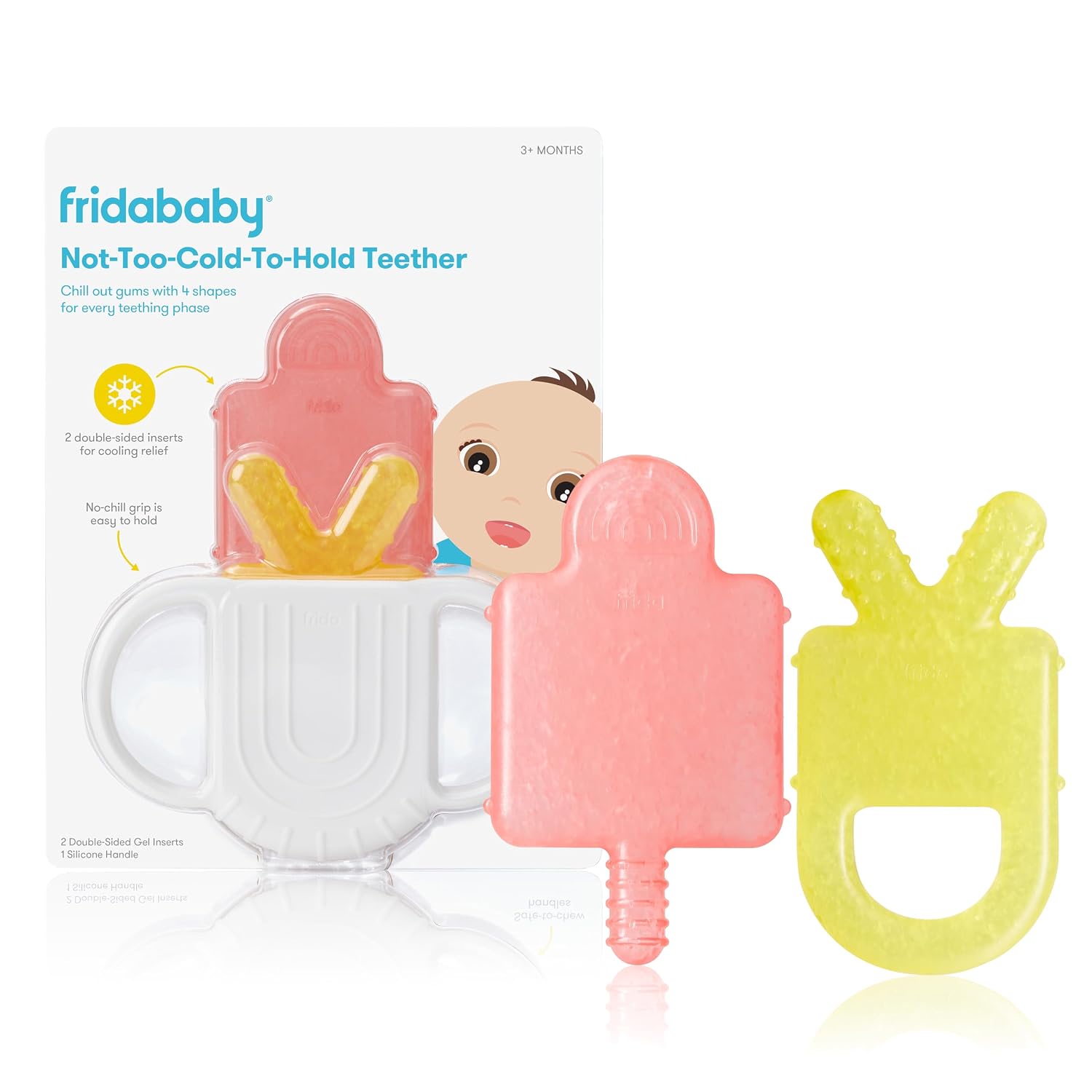
Narrow teethers work well here — a stem, a ring, a shape with a thin section. A large ball is difficult to bring to the exact spot a baby wants.
Eight to twelve months: the upper front teeth
The upper central incisors follow, then the lateral incisors on both jaws. Grip has improved considerably by now, so a teether with a handle or a ring earns its place: the baby can position it deliberately rather than gumming whatever lands.
This is also when teethers start being thrown, which is where a clip or a mitten stops being a gimmick.
Twelve to eighteen months: the first molars
Molars are wide, blunt and further back, and a front-loaded teether cannot reach them. What helps here is something with a broader chewing surface and enough length to be positioned towards the back of the mouth without being pushed too far.
Textured surfaces are more useful at this stage than smooth ones, because the pressure is spread across a wider tooth.
Sixteen to twenty-four months: canines and second molars
The canines and then the second molars complete the set. By this point most children have moved on from dedicated teethers to ordinary food and a toothbrush, and a chilled item is usually more welcome than a chew toy.
A fruit feeder with something cold in it often does more at this stage than anything from the teether shelf.
Cold, and how cold
Chilled is the useful temperature: an hour in the fridge, not the freezer. A frozen solid teether is uncomfortably hard against gums and, on water-filled designs, freezing can damage the seal.
Every manufacturer that permits chilling states it on the packaging, and the ones that specifically prohibit freezing say that too. Both are repeated on our product pages.
One-piece designs are easier to live with
A teether moulded in a single piece has nothing to come apart, nothing to trap moisture in a joint, and nothing to inspect. Multi-part designs — a ring with a rattle insert, a handle bonded to a head — are perfectly normal, but they need a look over every so often.
Whichever you choose, check the join line before each use once the toy has been in service for a few months.
How many you actually need
Two or three in rotation is plenty. One in use, one in the fridge, one clean and waiting covers a normal day without turning the kitchen into a storage problem.
Multipacks are good value for exactly this reason, which is why we keep several on the shelf under teether sets and multipacks.
What a teether will not do
A teether gives a baby something appropriate to bite. It does not speed up a tooth, prevent discomfort or shorten a difficult night, and any product described as doing so is describing something nobody has demonstrated.
We list what a teether is made of, what shape it is, whether it can be chilled and how it is cleaned. That is the whole of what a shop can honestly tell you.
Where to start on the shelf
For a first purchase, the silicone teethers page is the simplest place to begin. Cooling teethers cover the chilled options, teething mittens deal with the throwing stage, and fruit feeders and weaning picks up where teething leaves off.
Delivery timing is on the shipping policy page and the store phone is on the contact page — the counter is open from six in the morning until eleven at night, which is more useful than it sounds when you have a baby.
Why the order matters more than the dates
Parents tend to worry about the calendar and ignore the sequence, when it is the sequence that tells you what to buy. A baby whose lower incisors have just come through is going to want something narrow for weeks, regardless of whether those teeth arrived at five months or at nine. A baby working on first molars needs something broad and reachable at the back, whether that is at twelve months or at eighteen. If you shop by stage rather than by age you will be right almost every time, and you will not end up with a drawer of teethers bought for a month that had already passed.
It also means a single teether rarely lasts the whole journey. The narrow stem that was perfect at six months is close to useless against a molar, and the wide textured pad that helps at fourteen months would have been unmanageable at six. Two or three shapes bought at the right moments will always beat one bought early and hopefully.
What varies between children, and what does not
Timing varies enormously and is not a signal about anything. Some babies show a first tooth at four months and some at twelve, and both are entirely ordinary. What is far more consistent is the order — lower incisors, upper incisors, lateral incisors, first molars, canines, second molars — and the fact that molars tend to be the harder stretch simply because they are larger teeth arriving through more gum.
The other constant is that teething is intermittent. There are stretches where nothing seems to be happening and then a week where everything does. Keeping a small rotation of teethers clean and ready is a better strategy than reacting each time, which is invariably the moment everything is in the dishwasher.