
Teething mittens and clips: when they help

Teething mittens and clips: when they help
There is a stage, roughly between four and eight months, where a baby can grip an object but cannot reliably keep hold of it. Every teether ends up on the floor within a minute, gets wiped, and returns to the floor. Mittens and clips exist entirely to break that loop.
Both work. Both have a couple of things worth checking before buying.
What a teething mitten is
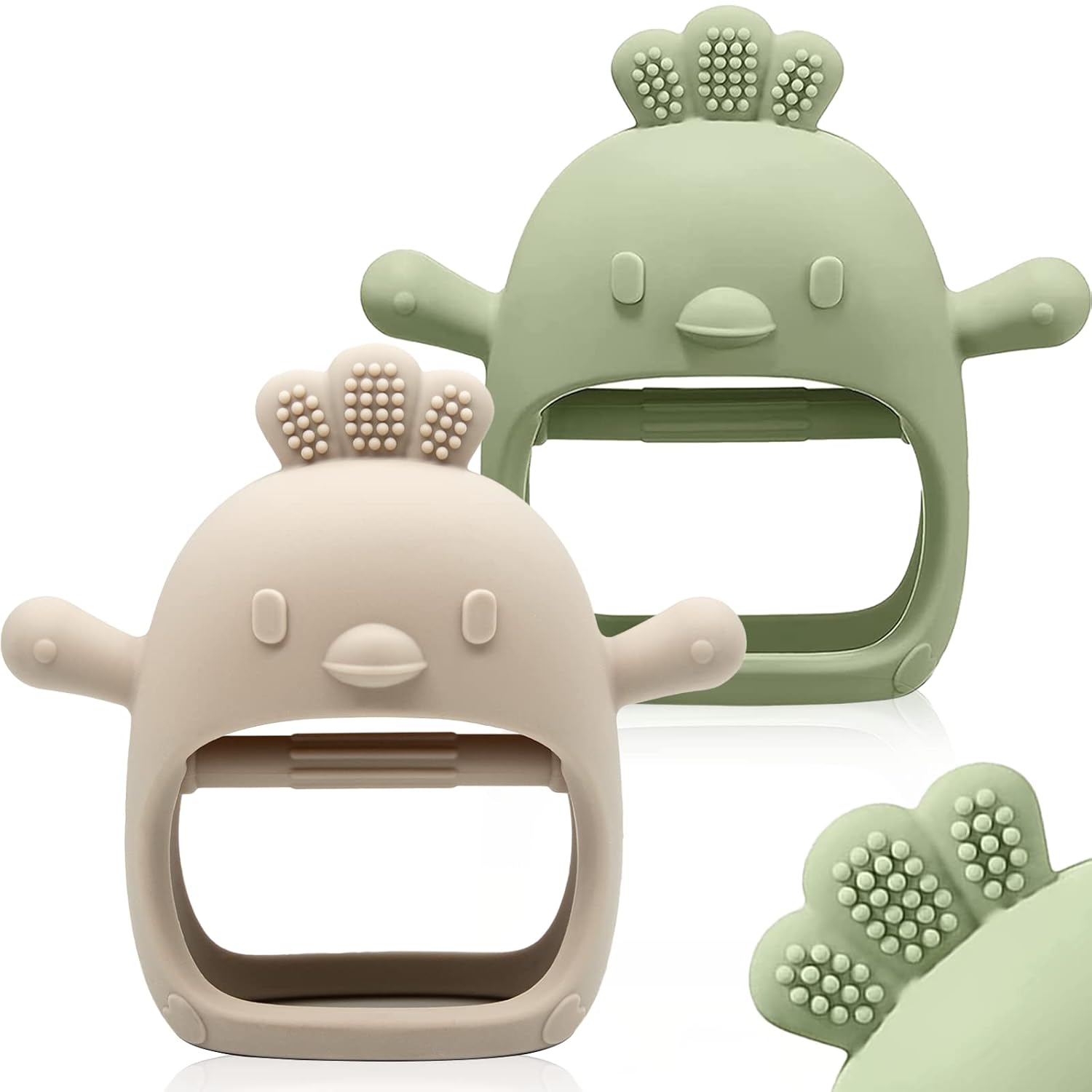
A fabric mitten that fastens around the wrist with a textured silicone panel over the back of the hand or the fingertips. The baby chews the mitten rather than a separate object, and because it is attached it cannot be dropped.
It also solves a second problem: babies chew their own hands at this stage anyway, and a mitten puts something appropriate between teeth and skin.
The fastening is the thing to look at
A mitten needs to stay on without being tight. Look for an adjustable closure and a soft cuff. Elastic-only cuffs are either too loose within a week or too tight from the start.
Check it can be removed one-handed, because you will be doing that while holding a baby.
Washability matters more here than anywhere
A mitten is mouthed constantly and sits against skin. It needs to be machine washable and to dry quickly — a design that takes a day to dry is a design you need three of.
Most are washable cool in a mesh bag. Air dry rather than tumble, for the same reasons as any fabric baby item.
Sizing and how long they last
Mittens have a shorter useful window than any other teether — a few months at most, because hands grow and because the chewing moves further back in the mouth. Buying two of the current size beats buying a size up.
Once molars start, a mitten no longer reaches where the chewing is happening, and the shelf moves on.
Clips: the other approach
A clip attaches a normal teether to clothing with a short ribbon or a silicone strand. The teether can be dropped but not lost, and it never reaches the floor.
The advantage over a mitten is that it works with any teether, including the chilled ones a mitten cannot replace.
Clip length is a genuine safety point
A clip strap should be short — long enough for the baby to bring the teether to their mouth and no longer. Anything with real slack is a wrapping risk, and there is no benefit to the extra length.
Clips are also for supervised use rather than for sleep, which every manufacturer states and which is worth repeating.
What to check on the clip itself
The clasp should open with deliberate pressure rather than easily, and it should have no exposed metal edge. The join between strap and clasp is the part that fails; give it a firm pull when new and again occasionally.
Replace at the first sign of fraying on a ribbon type.
Using both together
In practice most people end up with a mitten for the hand-chewing months and a clip afterwards for the chilled and molar-stage teethers. They are not competing purchases so much as consecutive ones.
Neither is essential. Plenty of babies get through teething with three silicone teethers and a lot of washing.
Out of the house
This is where both earn their keep. A mitten in a pram means nothing hits the pavement; a clip on a car seat means the teether stays in the car. A spare sealed in a bag turns a dropped teether into a swap rather than a problem.
The multipacks exist for exactly this reason.
Where they sit in the range
The mitten shelf is under teething mittens, with the standard options on silicone teethers and the chilled ones on cooling teethers. The stage-by-stage guide is at a teething timeline for the first two years.
Delivery and returns are on the FAQ, and the counter can be reached on the number on the contact page.
The stage where hands are the teether
Long before a baby can reliably hold an object, they can find their own hands, and they will chew them constantly. This is completely ordinary and it is the reason mittens exist at all: the alternative is not a different toy, it is a wet sleeve and reddened skin around the knuckles. A mitten simply puts a washable textured surface between teeth and hand, and it stays put because it is fastened rather than held.
It is worth understanding that a mitten is solving a different problem from a teether. A teether is something to bite; a mitten is something to bite that cannot be dropped or lost, at an age when everything is dropped and lost. Once grip becomes reliable, the problem disappears and so does the reason to own one.
What to check on a used or gifted one
Mittens and clips are commonly handed on between families, and both have parts that age. On a mitten, check the closure still holds — worn hook-and-loop that no longer grips is the usual failure, and a mitten that comes off is worse than none. Check the silicone panel for nicks along the edge where it meets the fabric, because that is where a bite lands hardest.
On a clip, pull firmly on the join between strap and clasp, and look for fraying on a ribbon type or any stiffening on a silicone one. Check the clasp still needs deliberate pressure to open. If any of that has softened, replace it — a clip is a few dollars and its whole job is to be reliable.