
Cooling teethers: fridge, not freezer

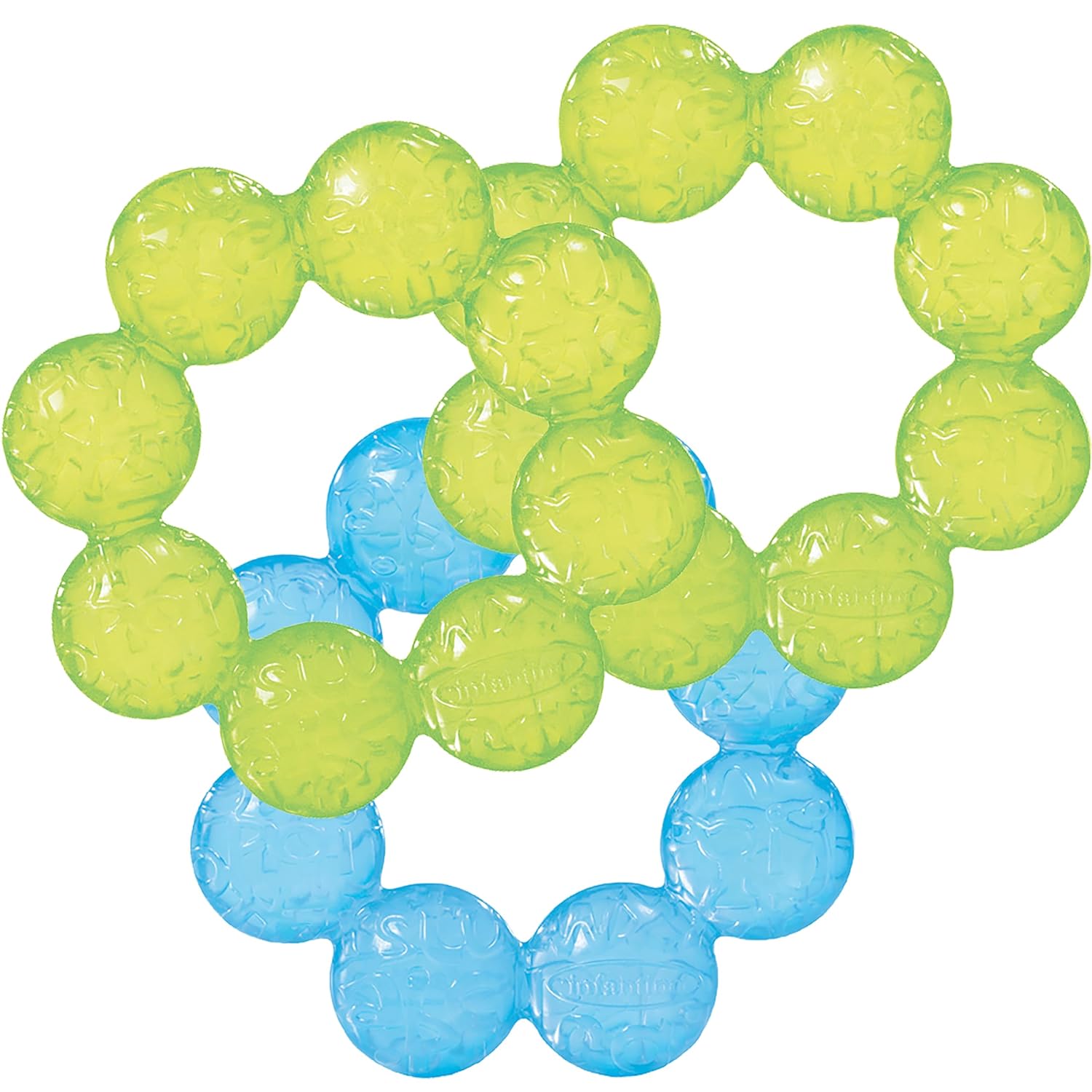
Cooling teethers: fridge, not freezer
Cooling teethers are among the most popular items on a teething shelf and among the most commonly misused. The instruction on almost every one of them is the same and is almost always ignored: refrigerate, do not freeze.
There are two good reasons for that, one about the baby and one about the product.
Frozen is too hard, not just too cold
Water and gel both become rigid when frozen. A teether that was designed to have a little give becomes a solid object, and pressing a solid object against a sore gum is not comfort.
Chilled to fridge temperature, the same teether stays flexible and is cool for long enough to be useful. That is the design intent.
Freezing damages the product
Water expands as it freezes. A sealed teether filled to a fixed volume has nowhere to put that expansion, and repeated freezing stresses the seam until it eventually fails.
A leaked cooling teether is finished — there is no repairing it and no safe way to keep using it.
Water-filled versus gel
Water-filled designs are usually clear, cool quickly and warm up quickly. Gel designs hold their temperature longer and often feel slightly softer. Both are sealed units and both follow the same fridge-only rule.
Which you prefer is mostly about how long a session lasts. For a short soothe, water is fine; for a longer one, gel holds up better.
Solid silicone in the fridge
A plain silicone teether can be chilled too, and it has the advantage of no seal to fail and no fill to leak. It does not stay cold as long, but it can be boiled, dishwashered and generally treated far more roughly.
For a first cooling teether this is often the more practical choice.
How long in the fridge
Thirty minutes to an hour is enough for most designs. Longer does no harm but adds nothing. Keeping two in rotation means one is always ready without anybody watching a clock.
Store them in a covered container rather than loose on a shelf, for the obvious reason.
Check the seam before every use
Run a thumb around the join. You are looking for any softness, bulging, or a change in the way the fill moves. A teether that has been repeatedly frozen will often show a slight distortion at the seam before it actually leaks.
If anything looks different from new, stop using it. These are inexpensive items and the check takes five seconds.
Cleaning a cooling teether
Outside only: warm soapy water and a thorough rinse, then dry. No boiling, no steam steriliser, no dishwasher unless the manufacturer specifically permits it — heat is as hard on a seal as freezing.
The full routine for every material is in cleaning and sterilising teething toys.
Alternatives when nothing is in the fridge
A clean damp washcloth chilled for twenty minutes does much the same job and can be thrown in the wash afterwards. It is not a product we can sell you, but it works, and it is what most people end up doing at some point.
For an older baby, cold food in a fresh food feeder often does more than any teether — that is what the feeders shelf is for.
What we list and what we do not
Every cooling teether on this site carries the manufacturer’s own chilling instruction and their explicit position on freezing. We do not add a recommendation of our own on top of it, and we do not claim any effect beyond being cold.
The range is under cooling teethers. Shipping is set out on the shipping policy page, and the store is on the phone from six in the morning — details on the contact page.
How long the cold actually lasts
This is the question that decides whether a cooling teether is worth having, and the honest answer is: not very long. A water-filled ring taken from the fridge is meaningfully cool for perhaps five to ten minutes in a warm room and in a warm mouth. Gel-filled designs stretch that somewhat. Nothing on this shelf stays cold for half an hour, and any product suggesting otherwise is describing a freezer, which is the one thing these must not go in.
That short window is why a rotation matters more here than anywhere else on the shelf. Two in the fridge and one in use is the arrangement that works; one teether and a lot of optimism is the arrangement that leads to somebody putting it in the freezer.
Signs a sealed teether has been frozen
Freezing damage is usually visible before it becomes a leak, and it is worth knowing what to look for on a second-hand or handed-down item. The seam may look slightly proud or uneven where it was previously flat. The fill may move differently — sluggishly, or with an air pocket that was not there before. On clear designs the liquid may look cloudy rather than transparent.
Any of those means retire it. A sealed teether is a sealed unit and there is no way to inspect the inside, so a change in the outside is the only warning you get. They are inexpensive items and a replacement costs far less than the alternative.